
Hey, Sheriff here 👋
There’s something I’d like you to know. In a past life, I was training for a career in healthcare.
This experience made me see many African healthcare problems firsthand.
Over the years, I’ve taken a stab at trying to solve them.
Today, I’ll be telling you the story of one of those problems and how it led me to the biggest racial divides in healthcare.
Let’s get into it…

There’s a stat that perfectly captures Africa’s entire healthcare reality in one painful sentence:
Africa has one dermatologist for every 1 million people.
Let that sink in.
In the U.S., it’s roughly one dermatologist for every 32,000 people.
In the U.K., it’s around one per 60,000.
On our continent? One doctor for ten stadium-sized crowds.
So, there’s high-grade, tested skincare for those who can afford it.
For most people, they’re left with fake, unregistered products.
And it’s only proof of one thing: the demand for skincare in Africa has never been higher.
But when you walk through any market in Lagos, Nairobi, or Accra, you’re more likely to meet the fakes.
In 2024, Nigeria’s drug regulator, NAFDAC, closed down the business of a “skincare influencer” who sold homemade skincare products to her audience of 100k+ people.
Since then, many others have sprung up in her place.
People want solutions. But they can't access experts.
So the market fills the gap, often with toxic substances.
But years ago, I tried to fix this problem.
And I hit a big wall
In 2020, I worked at Robotics and Intelligence Naira (RAIN), Nigeria’s first robotics and AI lab, on a simple idea: use AI to identify skin conditions from a photo.

This was me (first on the left) with a team of other researchers at the Robotics and Artificial Intelligence Nigeria lab in 2020.
This was two years before ChatGPT launched, but it was not rocket science either.
Dermatology AI models already existed abroad. Google Health, Stanford, and multiple startups were doing it. But no one had built it for Africa.
My plan was straightforward:
Collect thousands of labelled images of African skin conditions.
Train a neural network on this data.
Let anyone get an instant diagnosis with just a photo.
The tech wasn’t the hard part.
Python (a programming language) and Tensorflow (an AI framework) were easy, and I had access to powerful computers for training.
But there was one problem so massive, it swallowed the entire project: data.
There is no structured dataset of skin conditions on black skin.
The gold-standard global dataset for skincare, HAM10000, contains over 10,000 images of skin lesions.

The original dataset for the HAM10000 was actually gathered through an open-sourced challenge to different medical schools, to encourage them to use AI in diagnosis. These are some of the images of skin lesions collected.
But less than 2% are dark-skinned. Researchers still cite this as a major limitation today.
So I tried to hack the problem.
First, I tried searching medical websites for images of specific skin conditions.
Nine times out of ten, the skins were not black.
I had to get more creative.
So, I built a web scarper that scraped Instagram for posts tagged with “#acne,” “#eczema,” “#psoriasis,” “#dermatitis,” and other skin-related keywords.
What I got was… chaos.
Entire selfies. Motivational quotes. Memes. Cat photos. Anything but clean medical images.
I reached out to a founder in Spain who’d built something similar. He told me the truth I didn’t want to hear:
“There is no dataset for black skin. We wanted one too. We couldn’t find it.”

At the time, this founder had dropped out of medical school to launch an AI dermatology startup in Spain. He still runs the company today.
At that moment, it hit me.
The only way forward was to collect the data ourselves. From scratch. In the real world. Person by person, condition by condition.
But to do that, you need…dermatologists.
Which brings us back to the original tragedy:
Africa doesn’t have enough dermatologists to label the data we need to build the AI that could solve our shortage of dermatologists.
It’s a perfect circle of a problem.

A racial data gap hiding in plain sight
It dawned on me that I had stumbled into something bigger than a technical problem.
I had found a racial gap in global medical AI, a silent inequality baked directly into the datasets that power the future of healthcare.
And it wasn’t just skin conditions.
Across radiology, oncology, ophthalmology, and cardiology, study after study shows the same pattern:
African data is either missing, minimal, or mislabeled.
A few examples:
A 2023 Nature paper found that over 90% of genomic data used in medical research comes from people of European ancestry. Africans make up less than 2%, despite being the most genetically diverse population on earth.
A major global breast cancer AI system failed disproportionately on patients from sub-Saharan Africa due to a lack of representative training data.
A review of global radiology AI models found that fewer than 10% included data from African hospitals.
In short, AI is being trained to understand bodies that are not ours.
In July 2025, we even examined how AI can’t see black hair.
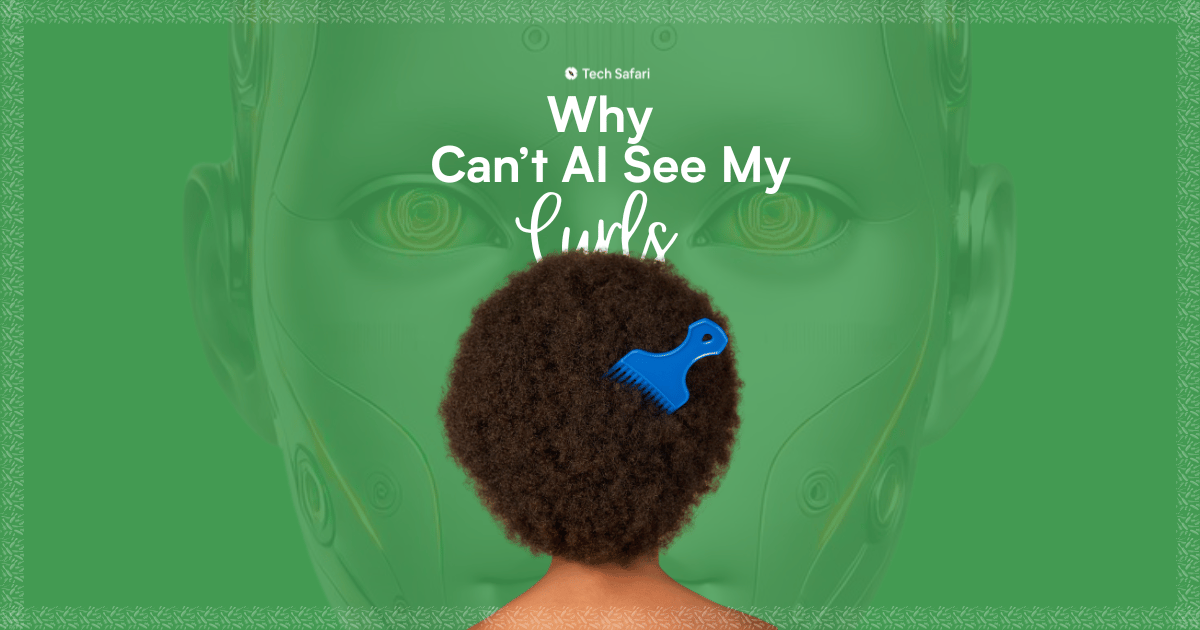
And no one is fixing it at scale.
Yet, what’s ironic is that as lacking as it is…
AI could plug Africa’s medical labour shortage
AI is perfectly positioned to solve Africa’s medical labour shortages.
Globally, AI is already doing incredible things:
Radiology models detect fractures, tumours, and pneumonia faster than humans.
Skin cancer classification models are matching top dermatologists.
AI triage systems reduce emergency room workloads by 40%.
Ophthalmology AI detects diabetic retinopathy in minutes.
Countries like the U.S., U.K., Singapore, and Israel are using AI to stretch their medical workers further, reduce costs, and increase accuracy.
Meanwhile, Africa is dealing with:
A shortage of 4.2 million healthcare workers (WHO).
One doctor per 5,000 people on average, compared to WHO’s recommended 1 per 1,000.
Persistent “brain drain” as African doctors migrate in tens of thousands every year.
Entire rural areas where the nearest dermatologist or radiologist might be 300km away.
Looking at this, AI seems less of a luxury and more of a lifeline.
But without good data, Africa can’t train (or localise) these models.
And with healthcare, foreign models perform poorly here.
Radiology images look different on older, analogue machines, the kind that’s common here.
Symptoms present differently on darker skin.
Genetic risk factors differ. Environmental exposures differ. Disease prevalence differs.
At the root of it all, the problem is…
Africa has a big data problem
When it comes to data, Africa is the most opaque continent on earth.
Every sector you can think of suffers from some kind of data poverty.
Let’s start with the most abundant thing in Africa: the people.
Many African countries haven’t conducted a reliable census in over 10 years. Nigeria’s last census was in 2006.
So, in reality, we don’t know how many people we have on the ground.
And it spreads to everything else:
Only 10% - 20% of land in Africa is formally titled. See how we don’t even know for sure?
Over 400 million Africans lack a formal address.
Over 100 million African kids under 5 were not registered at birth, and even death registration is below 30% in many countries.
And over 50% of hospitals on the continent rely solely on paper records, which leads to many diseases being underreported and misdiagnosed.
The problem is systemic, and its impact is felt in many different ways.
People who can’t access loans, land titles that can’t be proven, and diseases that can’t be accurately diagnosed.
But with AI, the consequences could be 10x.
Every sphere of the world is being ramped up with powerful models that can do things.
These models will seep into everything health-related, from drug design to medical systems.
If they’re built without African data, we could be permanently locked out of using them in any meaningful way, not just for skincare.
And here’s the thing about data: we can’t import it.
We need to build the rails for it from the ground up. But as we’ve seen in Africa, data collection is not a part of the culture.
And for small businesses and everyday people, it’s often seen as slow, pointless, and expensive.
But to get anywhere with AI, we need to fix this. So it’s worth asking…
What does building Africa’s data stack look like?
Simply put, it’s not glamorous. It’s everything people complain or worry about… and more.
It’s slow and expensive.
It requires experts, collection infrastructure, labelling, privacy frameworks, and a deep understanding among governments, companies and people on why it all matters.
But the payoff is enormous.
Imagine:
Africa’s first large-scale dermatology dataset.
A skin cancer classifier that works on black skin with 95% accuracy.
An AI triage system tuned to Nigerian hospital patterns.
A malaria diagnostic model trained on African blood samples.
A genomic database that unlocks drug discovery for African diseases.
We could finally build medical AI models that bridge the human workforce gap.
And if we replicate that across other sectors, Africa could have a real AI future.
When I ran into the data problem, I started a project called Skinbase to try to incentivise people to share images of their skin conditions, while we get a team of medics to label them correctly.
But these needed a bunch of things to work:
A critical mass of people informed enough to share the right kind of data
An incentive system to keep people donating images
And a team that could sort the collected data and make it useful for training
We put a team together and even got some donors. But without the incentive system, everything broke down, and we barely got 200 images.
Thinking back now, I wonder what other AI fruits Africa can’t reap because of its lack of data, and I can come up with quite a few…
What do you think about Africa’s data problem?
PS: And if you know anyone else who’s building data infrastructure for Africa’s future, share this with them.

How We Can Help
Before you go, let’s see how we can help you grow.
Get your story told on Tech Safari - Share your latest product launch, a deep dive into your company story, or your thoughts on African tech with 60,000+ subscribers.
Partner on an upcoming event - You and 200+ of Africa’s top tech players in a room together for an evening.
Hire the top African tech Talent - We’ll help you hire the best operators on the continent. Find Out How.
Invest with Tech Safari - Our private syndicate invest in the most exciting early stage startups in Africa.
Something Custom - Get tailored support from our Advisory team to expand across Africa.

That’s it for this week. See you on Sunday for a breakdown on This Week in African Tech.
Cheers,
The Tech Safari Team
PS. refer five readers and you’ll get access to our private community. 👇🏾

What'd you think of today's edition?

Wow, still here?
You must really like the newsletter. Come hang out. 👇🏾